
To better understand Warsaw—and Poland as a whole—it helps to explore its history. It is rich and fascinating, though often marked by tragedy. Whether you choose a deep dive or a brief overview, understanding the past provides essential insight into the present. For those without the time to read lengthy history books, I’ve included a concise summary of Warsaw’s history, organized into key time periods that, in my view, have left a lasting imprint on the city.
The Legend:
The founding of Warsaw is tied to a beloved legend about a fisherman named Wars and a mermaid named Sawa. According to the story, Wars lived along the banks of the Vistula River, where he encountered Sawa, a magical mermaid who had been captured but later freed. In gratitude, she blessed the land and promised prosperity to the settlement that would grow there. The town that emerged was named after the pair—Wars and Sawa—eventually becoming Warsaw. Today, the mermaid, known as Syrenka, remains a symbol of the city, appearing on its coat of arms and in statues throughout the Old Town.
The Beginnings (through 1596):
Although almost 700 years old, Warsaw is considered to be a young city by Polish standards. Warsaw was only starting to emerge as a city from the Mazovian forest, when cities such as: Krakow, Gdansk, Wroclaw or Kalisz were celebrating their quincentenaries.
The history of Warsaw begins as a modest settlement along the Vistula River, likely established in the late 13th century within the region of Mazovia. Its location along an important trade route helped it grow steadily from a small fishing and trading village into a developing town. By the early 14th century, Warsaw received city rights and began to fortify itself with walls and a market square, laying the foundation for what is now known as the Old Town. During this period, it was part of the Duchy of Mazovia, ruled by local Piast princes rather than the Polish crown. In the 15th century, Warsaw’s importance increased as it became one of the main seats of the Mazovian dukes. The construction of the ducal residence—later expanded into what would become the Royal Castle—reflected the city’s growing political role. Churches such as St. John’s Archcathedral were established, strengthening Warsaw’s religious and civic life. Its position on the Vistula made it a key point for trade between regions, attracting merchants and craftsmen and steadily increasing its population. A major turning point came in 1526, when the Duchy of Mazovia was incorporated into the Kingdom of Poland after the death of its last ruler. From that point on, Warsaw became more closely integrated into the Polish state. Its central location made it an increasingly convenient meeting place for sessions of the Polish parliament (Sejm), drawing nobles and political figures from across the realm. Over the course of the 16th century, Warsaw continued to grow in both size and influence, setting the stage for its rise to national prominence. By the late 1500s, Warsaw had effectively become a political hub of the Polish-Lithuanian Commonwealth, even before it was formally recognized as the capital. Regular parliamentary sessions, royal visits, and its strategic location all contributed to its ascent. This gradual rise culminated in 1596, when King Sigismund III Vasa moved his court there, marking the beginning of Warsaw’s long-standing role as the capital of Poland.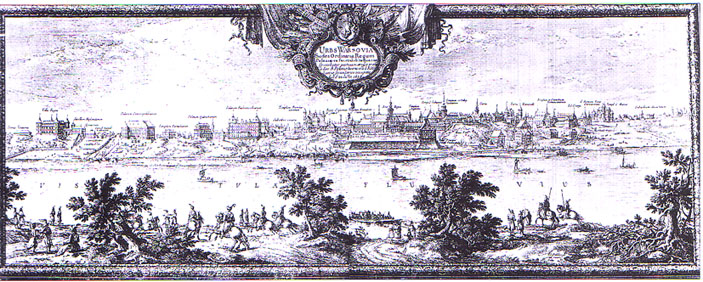
A view of Warsaw from the right bank of the Vistula (circa 1656).
Warsaw - The Capital of Poland (1596):
In 1596, Warsaw became the capital of Poland under the rule of Sigismund III Vasa, marking a significant shift from the historic capital of Kraków. This decision was not made through a formal decree establishing a new capital in the modern sense, but rather evolved as the king chose to move his royal court and administrative functions to Warsaw. One of the key reasons for this move was Warsaw’s more central location within the vast Polish-Lithuanian Commonwealth, which stretched from the Baltic Sea deep into Eastern Europe. From Warsaw, it was easier to govern both the Polish Crown and the Grand Duchy of Lithuania. Another important factor was a devastating fire at Wawel Castle in 1595, which damaged the traditional royal residence in Kraków. Rather than fully restoring it as the primary seat of power, Sigismund III increasingly favored Warsaw, where the Royal Castle became the center of political life. Warsaw had already hosted sessions of the Polish parliament (the Sejm), making it a familiar and practical meeting place for nobles from across the Commonwealth. Over time, the king’s continued presence in Warsaw drew government officials, diplomats, and members of the nobility to the city. What began as a practical relocation gradually transformed Warsaw into the political heart of the state. By the early 17th century, it was widely recognized as the de facto capital of Poland, a status it has maintained ever since.
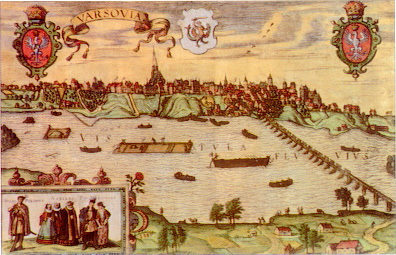
A 16th century depiction of Warsaw.
Partitions of Poland (1792-1795):
In the final years of the 18th century, Warsaw stood at the center of a collapsing state. As the capital of the Polish-Lithuanian Commonwealth, the city became a focal point for reform and political struggle. In 1791, the historic Constitution of May 3 was adopted in Warsaw, representing one of Europe’s first modern constitutions and a bold attempt to strengthen the weakened Commonwealth. For a brief moment, it inspired hope that the country could reform itself and preserve its sovereignty. That hope was short-lived. In 1792, opposition from conservative nobles—organized in the Targowica Confederation—invited intervention from the Russian Empire. Russian forces entered Warsaw, and the reform movement was dismantled. The city, once alive with political debate and reformist ambition, came under foreign influence and growing instability. This period marked the beginning of the end for the Commonwealth, as external powers increasingly dictated its fate. By 1795, after a series of military defeats and uprisings, including the failed Kościuszko Uprising led by Tadeusz Kościuszko, the final partition of Poland erased the country from the map of Europe. Warsaw fell under Prussian control, losing its status as a national capital. The city entered a long period of foreign rule, and its political and cultural life was deeply constrained. Yet even in defeat, Warsaw remained a symbol of Polish identity and resilience, preserving the memory of independence during a time when the nation itself no longer officially existed.
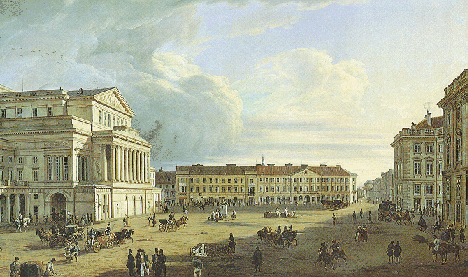
The Grand theater (Teatr Wielki) in Warsaw around the early 19th century.
Polish Independence and the Interwar Period (1918 - 1939):
After World War I, Warsaw emerged as the capital of a newly independent Poland in 1918, following more than a century of partitions by neighboring empires. The rebirth of the Polish state brought a surge of national pride and energy to the city, which quickly became the political, cultural, and economic center of the Second Polish Republic. Government institutions, universities, and cultural organizations flourished as Warsaw worked to reestablish itself on the European stage. One of the most critical moments of this period came during the Battle of Warsaw in 1920, when Polish forces successfully defended the city against the advancing Red Army. Often referred to as the “Miracle on the Vistula,” this victory not only secured Poland’s independence but also halted the spread of communism further into Europe. The triumph solidified Warsaw’s role as a symbol of national resilience and determination. Throughout the 1920s and 1930s, Warsaw experienced rapid urban growth and modernization. New infrastructure, including roads, public transportation, and modern buildings, transformed the city into a bustling metropolis. At the same time, it was a vibrant cultural hub, home to a diverse population that included one of the largest Jewish communities in Europe. However, political life was not without tension—especially after the 1926 coup led by Józef Piłsudski, which ushered in a more authoritarian style of governance. By the late 1930s, despite ongoing cultural and economic development, Warsaw faced growing uncertainty as tensions in Europe escalated. The city’s progress was abruptly halted in 1939 with the outbreak of World War II, when Nazi Germany invaded Poland, marking the end of the interwar period and the beginning of one of the darkest chapters in Warsaw’s history.
World War II and the German occupation (1939 - 1945):
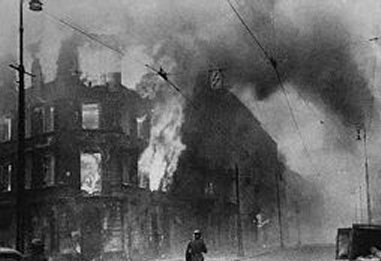
The Warsaw Ghetto is burned down.
The years between 1939 and 1945 were among the darkest in the history of Warsaw. In September 1939, Nazi Germany invaded Poland, marking the beginning of World War II. Warsaw was heavily bombed and besieged before capitulating later that month. Soon after, the city fell under brutal German occupation, and daily life became defined by repression, fear, and severe hardship for its inhabitants. One of the most tragic chapters was the creation of the Warsaw Ghetto in 1940, where hundreds of thousands of Jews were forcibly confined in overcrowded and inhumane conditions. Disease, starvation, and deportations to extermination camps devastated the population. In 1943, the imprisoned Jewish community launched the Warsaw Ghetto Uprising, a courageous but ultimately doomed revolt against Nazi forces. The uprising was brutally suppressed, and the ghetto was systematically destroyed. In 1944, as Soviet forces approached the city, the Polish underground resistance initiated the Warsaw Uprising in an effort to liberate Warsaw before Soviet arrival. For 63 days, fighters battled German troops in intense urban combat. Despite initial successes, the uprising lacked sufficient external support and was eventually crushed. In retaliation, German forces carried out mass executions and ordered the near-total destruction of the city. By the time the war ended in 1945, Warsaw had been almost completely annihilated, with an estimated 85% of its buildings reduced to rubble. Much of its population had been killed, displaced, or deported. Yet despite this devastation, the spirit of the city endured, laying the foundation for the massive reconstruction effort that would follow in the postwar years.
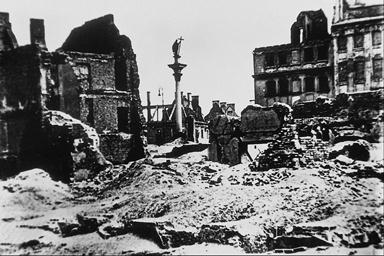
The aftermath of the Warsaw Uprising in October, 1944. The Old Town lays in ruins.
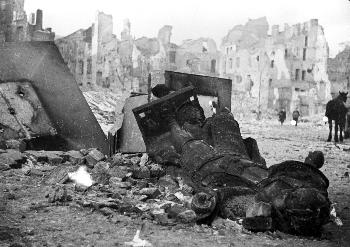
The statue of King Zygmunt after the column supporting it was blown up.
Post-War Years, the Socialist Utopia and the Iron Curtain (1945 to 1989):
After World War II ended in 1945, Warsaw lay almost completely in ruins—an estimated 85% of the city had been destroyed, largely as a result of the Warsaw Uprising and subsequent German retaliation. Under the new Soviet-backed communist government, a massive reconstruction effort began. The Old Town was painstakingly rebuilt using historical paintings and records, eventually earning recognition as a symbol of resilience. At the same time, the city was reshaped along socialist lines, with wide avenues and monumental architecture reflecting the ideology of the era. One of the most prominent symbols of this period was the construction of the Palace of Culture and Science, completed in 1955 as a “gift” from the Soviet Union. It became the tallest building in Poland and a lasting reminder of Soviet influence. Throughout the late 1940s and 1950s, Warsaw was the political center of the Polish People’s Republic, governed under strict communist control aligned with Soviet Union policies. Daily life was marked by censorship, limited political freedom, and economic hardship, though the city slowly regained its population and cultural life. By the 1970s and 1980s, growing dissatisfaction with the government led to increased protests and the rise of opposition movements. The emergence of the Solidarity in 1980 marked a turning point, as workers and intellectuals united to demand reforms. Although martial law was imposed in 1981 to suppress dissent, resistance continued throughout the decade. Finally, in 1989, a series of negotiations known as the Round Table Talks led to semi-free elections, signaling the end of communist rule in Poland. For Warsaw, this marked the beginning of a new chapter—transitioning from a tightly controlled socialist capital to a democratic and rapidly modernizing European city.
Post-Communism to European Integration (1989 to 2004):
From 1989 to 2004, Warsaw experienced one of the most significant periods of transformation in its history. The turning point came in 1989 with the partially free elections following the Round Table Talks, which marked the end of communist rule in Poland and the beginning of democratic governance. In the years that followed, Warsaw rapidly transitioned to a market economy, leading to widespread privatization, the emergence of entrepreneurship, and a surge of foreign investment. During the 1990s, the city’s skyline began to change dramatically. Modern office towers, hotels, and shopping centers appeared, particularly in the city center, while historic districts such as the Old Town—meticulously rebuilt after World War II—continued to be preserved and revitalized. Infrastructure also improved, including roads, public transport, and the launch of the first line of the Warsaw Metro in 1995, signaling a new era of urban development. Culturally, Warsaw reemerged as a vibrant European capital, with a growing arts scene, international events, and expanding educational institutions. By the early 2000s, the city had firmly established itself as Poland’s economic and political hub. This period of transformation culminated in 2004, when Poland joined the European Union. EU membership brought increased funding, modernization projects, and stronger integration with Western Europe, solidifying Warsaw’s position as a dynamic and rapidly developing capital city.
2004 to Present:
From 2004 to today, Warsaw has continued its rapid development following Poland’s accession to the European Union. EU funding helped modernize infrastructure across the city, including expanded public transportation, new roads, and the continued growth of the metro system. The skyline evolved further with the construction of striking high-rises, most notably the Palace of Culture and Science being joined by modern towers like Varso Tower, symbolizing Warsaw’s emergence as a major business hub in Central Europe. Throughout the 2010s, Warsaw strengthened its reputation as a center for finance, technology, and international investment, while also investing heavily in cultural institutions, museums, and green spaces. The city balanced modernization with preservation, maintaining its historic charm alongside contemporary architecture. In recent years, Warsaw has also played an important regional role, particularly in response to the Russian invasion of Ukraine, providing support to refugees and reinforcing its position as a key political and humanitarian hub in the region. Today, Warsaw stands as a dynamic, resilient, and forward-looking European capital that continues to evolve while honoring its complex past.